


New research reveals early betel nut drug use in Indonesia
Ancient teeth from Sulawesi dating back 25,000 years potentially mark the earliest known use of a psychoactive plant
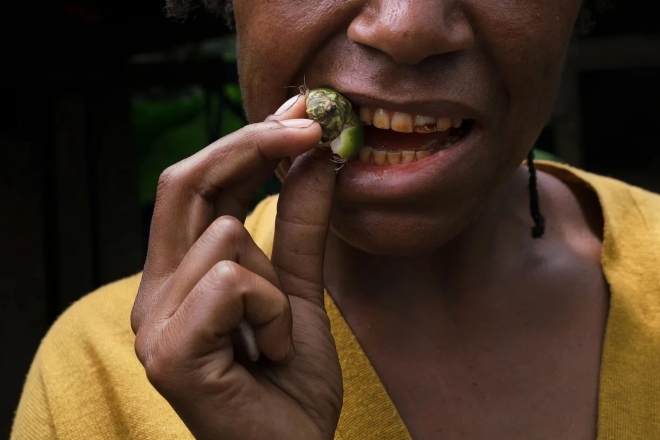
A recent study published in Science Advances reported evidence of psychoactive plant use in the teeth of two prehistoric hunter-gatherers from Sulawesi, Indonesia.
It's now being stated as the earliest known case of habitual use of a neuroactive plant drug.
Though practiced by one in 10 people globally, the early history of betel nut use remains largely unknown, until now.
Futura-Sciences reports that one individual lived 25,000 to 16,000 years ago and the other 7,600 to 6,300 years ago. Both had tooth wear consistent with repeated chewing of betel nut, the seed of a palm that grows in tropical Asia and the Pacific.
Dental tissue contained arecoline, a compound that increases alertness and reduces fatigue.
The study states that the people of Sulawesi were prone to cavities, and arecoline also relieves pain. Researchers suggest they may have chewed the nut to ease toothache.
Lead author Adam Brumm told Futura-Sciences that the abrasive nut would have worn the teeth down to the pulp: "It must have been extremely painful. It would have made eating very difficult, while raising the risk of chronic infection."
According to CNN, Brumm's team proposes that Austronesian farmers, who spread out of Taiwan and reached Sulawesi about 4,000 years ago, adopted the practice and added chewing the nut with slaked lime.
Read this next: Concerns psychedelic treatment could be “just for the rich” following Australia legislation
Betel nut is still commonly used across Asia and the Pacific, and Taiwan has its own archaeological record.
In 2024, the South China Morning Post reported that two skeletons estimated at 2,500 to 2,700 years old have red mineral stains on their teeth, which researchers believe are betel juice residue. The skeletons came from tombs uncovered in 2021 during railway construction in Chiayi City.
Other parts of Asia also have a long history with psychoactive drug use. A 2023 review in the Indian Journal of Psychological Medicine identifies the Atharva Veda, dated about 2000 to 1400 BC, as the earliest mention of Bhanga (cannabis preparation), described as “a sacred grass”.
Read this next: Magic mushrooms can be used to treat severe depression, according to new study
The review notes that the indigenous Cannabis indica strain has grown wild along the Himalayan foothills and nearby plains for centuries, with cannabis also holding a significant place in Hindu religious life and scriptures, particularly in India and Nepal.
Plant-based substances have long been used to treat illness and pain. In South America, ayahuasca originates in the Amazon, where Indigenous communities have used it for communal or social support, according to Georgia Institute of Technology historian Taylor Elizabeth Dysart.
In recent years, there’s been growing discussion around using psychedelics such as psilocybin, ketamine and LSD to treat depression, anxiety and PTSD.
Read the study on early betel nut drug use here.
Amira Waworuntu is Mixmag Asia’s Managing Editor, follow her on Instagram.
Never miss a beat. Subscribe to our Scene Report newsletter or follow us on Instagram.
