


 Features
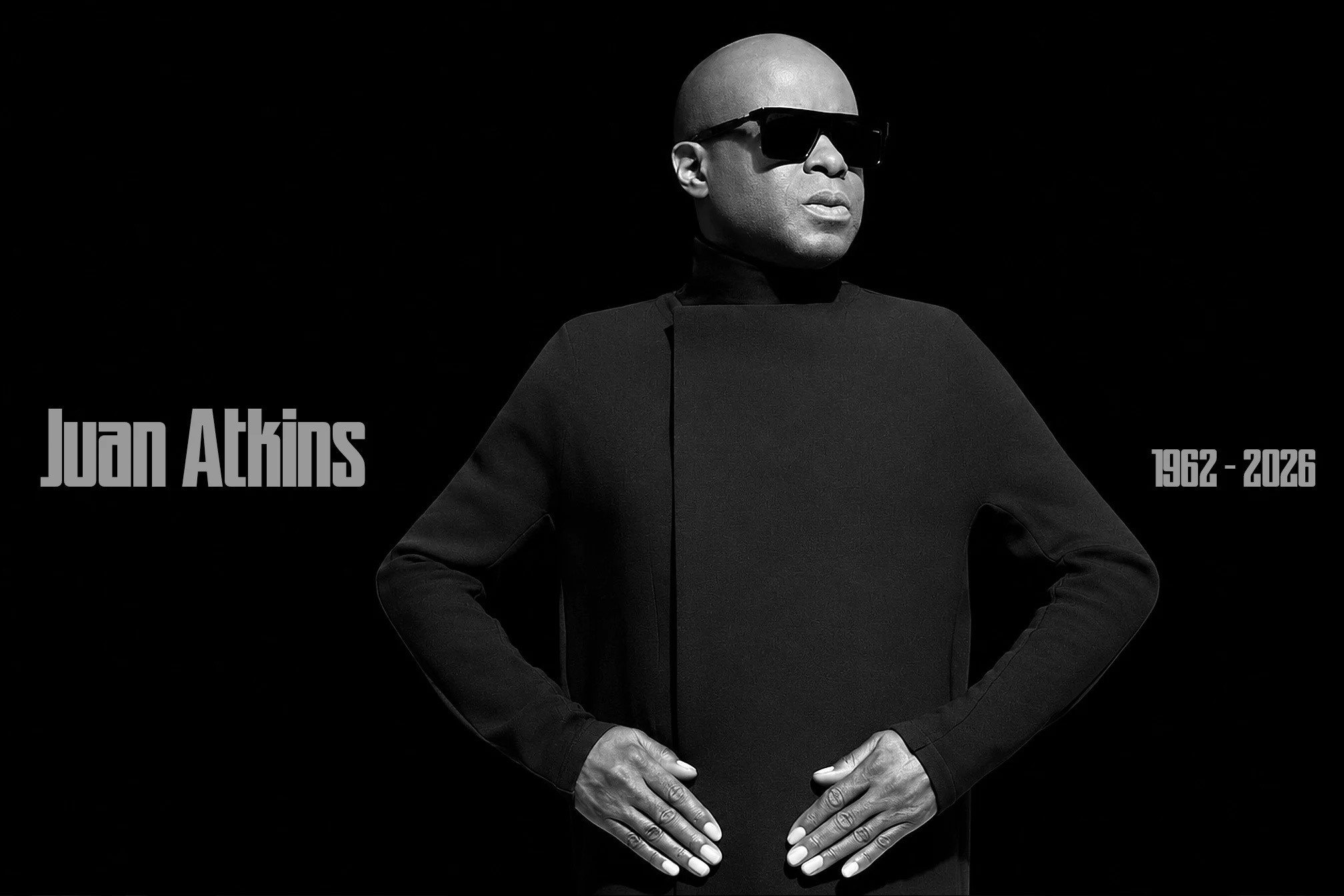
RIP Juan Atkins, the techno originator who changed the world
Juan Atkins was the pioneer whose foundational influence has inspired everyone. Not just an all-time titan of dance music, but of music full stop. Marcus Barnes pays tribute to the innovator who never stopped looking forwards
Juan Atkins died on October 31 at the age of 64 in Mexico City. Widely regarded as “The Originator” or “The Godfather of Techno”, he was a visionary whose creativity and innovation is the essence of techno music. Over the last 24 hours social media has been awash with tributes from across the electronic music community, with a wide range of pioneers, luminaries and influential artists crediting Juan with inspiring them. The sense of loss is huge, not only for what he contributed to the lineage of electronic music, but for the pure and humble nature he embodied and the future projection he channeled into his output.
Juan was born in Detroit before moving to Belleville, a western suburb of the city, around 29 miles (47km) from Downtown Detroit. At Belleville high school he bonded with Kevin Saunderson, whose family had moved to the area from New York, and Derrick May, who’d also relocated from Detroit. They were among a small percentage of Black students at the school, which brought them together. Little is known about Juan’s parents besides reports that his father was a concert promoter, and that his grandmother was key to his upbringing - taking care of him and his brother for some time during his youth.
Juan’s grandmother, Lily, played a pivotal role in his musical development. She encouraged and nurtured his love for music. In his younger years he would play her Hammond B-3, a 1950s electronic organ which was widely used in jazz, gospel and R&B circles - essentially, this was Juan’s first electronic instrument. It was Lily who bought him his first synthesiser: a Korg MS-10. “My grandmother had this Hammond B-3 organ and I used to mess around with it. I think I was in second grade, I must have been seven or eight years old. I would go with her to a shop called Grinnell’s [Grinnell Brothers Music House] where they sold all these organs and pianos.” he told me during an interview at Belfast’s AVA Festival in 2016. “Grinnell’s had this back room, where they would showcase the new keyboards when they came out. So, when she was in the front buying sheet music or getting her organ repaired, I’d be in the back messing around with the Korg MS-10 or a Minimoog, when they were just being introduced for consumer use. One day we were in there and either my birthday or Christmas was coming up and I brought her into the room and said, ‘Grandma, I really want this machine’ and she bought it for me.”
Another key figure in Juan’s early grounding was the enigmatic DJ The Electrifying Mojo - a radio host on WGPR (Where God’s Presence Radiates – Michigan’s first Black-owned FM radio station). As FM was still emerging as a radio frequency, everything was new and formats were loose, allowing for creative individuals like Mojo to formulate shows that were diverse, immersive and experimental. Mojo’s influence was critical - his show, The Midnight Funk Association, introduced Juan, Kevin, Derrick and many other techno pioneers (and the wider Black community) to everything from The B-52s to Depeche Mode, Kraftwerk and much more.
Kraftwerk were, of course, critical to Juan’s formative years, too. “When I heard ‘We Are The Robots’, it just matched what was going on in the city at the time,” he told me during a 2016 interview. His earliest compositions carry some of the spirit of Kraftwerk’s output, blending European electronic influences with the soul, funk and groove of Black music. “The first place I heard it was on Mojo’s show and it just froze me in my tracks because I was doing music, and it was totally electronic, but this was the first time where I heard it really precise,” he said.
From his first releases as Cybotron, Alley Of Your Mind’ (1981), ‘Cosmic Cars’ (1982) and the seminal ‘Clear’ (1983), to his early work as Model 500, ‘No UFO's’ and ‘Night Drive (Thru Babylon)’, the first iteration of Juan’s emerging sound was almost like a distillation of everything Mojo played on his show. It all came full circle when The Electrifying Mojo championed Juan’s own music, elevating his projects and introducing his music to WGPR listeners across Detroit.
It’s mind-boggling to consider just how influential Juan Atkins has been. Besides being a mentor of sorts to Derrick May and Kevin Saunderon, two other founders of techno, Juan also coined the term “techno” in the first place. This was inspired by futurist writer Alvin Toffler, whose work he was introduced to in a high school class called Future Studies. From Toffler’s writing Juan and his creative partner Richard ‘3070’ Davis created their own techno-speak, alongside the future-facing music they were making. Toffler uses the phrase “techno-rebels” in the 1980-published book The Third Wave. Metroplex, the name of Juan’s label, also comes from Toffler, who used the term 'metrocomplex', a future word that referred to his scenarios in The Third Wave and his preceding 1970 book Future Shock where cities over the world would grow so big that they would all become one. An early form of sonic Afrofuturism before the term was even coined in the '90s. Another book that Juan got into was Arthur C. Clarke’s Childhood’s End. Published in 1953, it depicts alien lifeforms arriving on planet Earth as benevolent custodians, who bring an end to war, racism and animal cruelty and help usher humanity into an age of computerised abundance.
Beyond Detroit, the music became synonymous with hip hop culture and, upon crossing the Atlantic, Europe’s emergent dance music scene. DJs, producers, breakdancers and fans embraced ‘Clear’, named by Carl Cox as a track that “has never left my soul” and sampled by Timbaland on Missy Elliott’s hit ‘Lose Control’, among wide citations as a key influence by many electronic pioneers from around the world. A few years after its release, his Metroplex records filtered into stores across the UK and Europe, along with other first wave techno releases, ushering in a new era for electronic music.
Juan formed a close connection with Berlin, continuing a cultural exchange that had begun with Kraftwerk and their inspiration from Motown Records. The bond between Juan and his German counterparts began when Moritz Von Oswald, Thomas Fehlmann and Mark Ernestus visited Detroit. “Me and Mike Banks were living in this building on 2030 Grand River [Avenue], and they came to this building wanting to meet us. I got a knock on my door one morning, it was Mike and these three German guys who wanted to meet me,” he explained in 2016. “They were buying up old [music tech] gear from the pawn shops, and they’d take them back to Germany and retrofit them with MIDI.”
Juan recorded an album with them in 1992, for which the trio used the group name 3MB. The album - ‘3MB Feat. Magic Juan Atkins’ - was released on Berlin-based label Tresor, the in-house imprint of the eponymous nightclub. This further solidified the German connection, what’s become known as the Berlin-Detroit axis.
“From the very beginnings of our club and label, Juan has been part of our family. The relationship between Detroit and Berlin was never simply a musical exchange. It was a bond built on shared ideas, friendship, trust and the belief that music could open doors to another world. Juan stood at the heart of that bond. His spirit, his imagination and his music are woven into the very foundations of who we are,” Tresor shared on social media. “On the final night of the original Tresor, the last track played was Juan’s ‘I Love You’, from a cassette he had personally given Dimitri [Hegemann] just three days earlier. When it ended, it was played again. His music carried us through the final moments of a place where a generation from East and West had come together to begin a new musical era. It was Juan’s declaration of love for a club that had become a meeting point between Detroit and Berlin, a place where his music had found a home and from which it travelled into the world.”
Germany became a centrepoint for European techno, as did The Netherlands and Belgium. Cities including Berlin, Frankfurt, Brussels, Antwerp and Ghent embraced the music and its pioneers, as well as spawning their own artists, labels and clubs. Juan’s essence is in the DNA of so much of today’s electronic music. Techno was also essential to the conception of jungle and drum ‘n’ bass, for instance. Fabio & Grooverider famously mixed techno records with Belgian releases, dub B-sides, sped-up house and more to create the early breakbeat-driven sounds that evolved into jungle. Not only that but its DNA permeated into numerous musical movements, including UK rave culture, hardcore, and beyond.
Over the course of his musical progression Juan has always looked forward, never replicating what came before. In the '90s his sound evolved further, with albums like ‘Deep Space’ (released on Belgian label R&S in 1995) and ‘Skynet’ (released under his Infiniti alias on Tresor in 1998) demonstrating his creative growth. His inherent focus on the future and innovation also led to projects like Borderland with Moritz Von Oswald, a dream team collaboration that resulted in three EPs, two singles and an album, ‘Transport’, released in 2016.
Juan never stopped working, driven by an innate desire to simply continue creating. He has performed all over the world, DJing and playing live. In 2023 he brought back Cybotron, and in 2025 performed a stunning live show at Glastonbury with Moritz’s nephew Laurens von Oswald and fellow Detroiter Tameko Williams (AKA DJ Maaco from Detroit In Effect). Making its debut at the festival's IICON stage at Block9, the show merged Cybotron's futuristic sound with an ambitious visual production created by a team who, in their own words, "jammed with technology" - namely AI - to create the blueprint for a parallel Cybotron world. One of the tracks performed at the show was "basically all AI-generated", Juan told me earlier this year. He’d been working on an album, called ‘12’, where he was incorporating AI technology. Plenty of pioneering artists can become prisoners of their own legacy, endlessly revisiting the records that made them famous. Juan didn't operate that way - even in his sixties, he was experimenting, developing new live concepts, touring and making new music. In fact, he continued touring despite his ailing health. One of his last-ever sets was back-to-back with his daughter Milan, at ADE event Four Decades of Detroit Techno, held on October 23 eight days before his passing.
I’ve interviewed Juan three times, twice this year, and he’s always had a humility and grace that belies his standing within electronic music heritage. I’ve loved his music for many years now, and even started working for his label Metroplex - via Elypsia Music Group - very recently. Scrolling through my social media feeds over the past day revealed a deluge of posts honouring Juan and his impact on individuals and wider electronic music culture. Everyone has a story about how his music touched them, or inspired them, or how Juan himself was pivotal in their musical career.
The feelings of loss are ubiquitous and it’s difficult to describe how one person’s ingenuity has had such widespread and definitive influence. Talking to me about making music earlier this year, he said: “It’s just inherent. I would be doing this regardless of getting paid, and it’s something I'm going to take to my grave.” That was in January and, though he’s been struggling with health issues for some time, I don’t think he could have imagined he would be taking his music making to the grave so soon.
More than 40 years since Juan Atkins coined the term techno, the music is still very much alive and kicking, in various forms and styles. It reverberates through the darkest underground clubs and the pop charts, influencing so much of what we listen to. There are few artists in music who can lay claim to such a vast legacy.
A visionary in the truest sense of the word, we are all indebted to Juan Atkins and his pioneering contribution to electronic music. He was part of a particular moment in Black American musical history, technological experimentation and cultural exchange that fundamentally changed the direction of global music. A creative force of nature who was one of a kind.
RIP.
Marcus Barnes is a freelance writer and regular contributor to Mixmag, follow him on Instagram
