


 Features
From The Archive: Between ‘Homework’ and ‘Discovery’, Daft Punk were on the brink of world domination
Live life the Daft Punk way: Make millions, then blow it all on metal heads, your own version of Napster, and recording the most exciting album of the decade. In 2001, Mixmag spoke to Cover Stars Daft Punk just before the release of their influential second album ‘Discovery’ — and here’s what they had to say
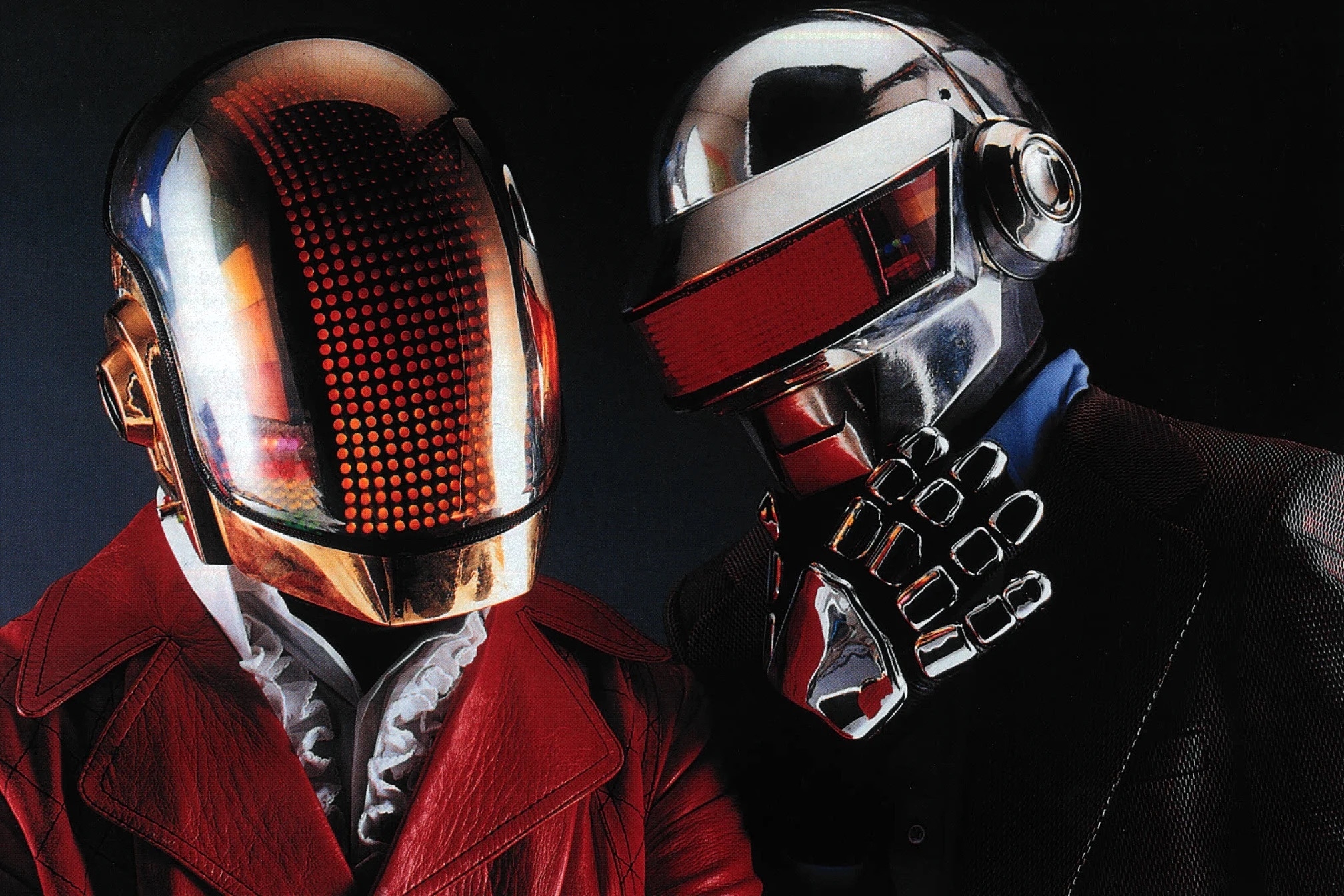
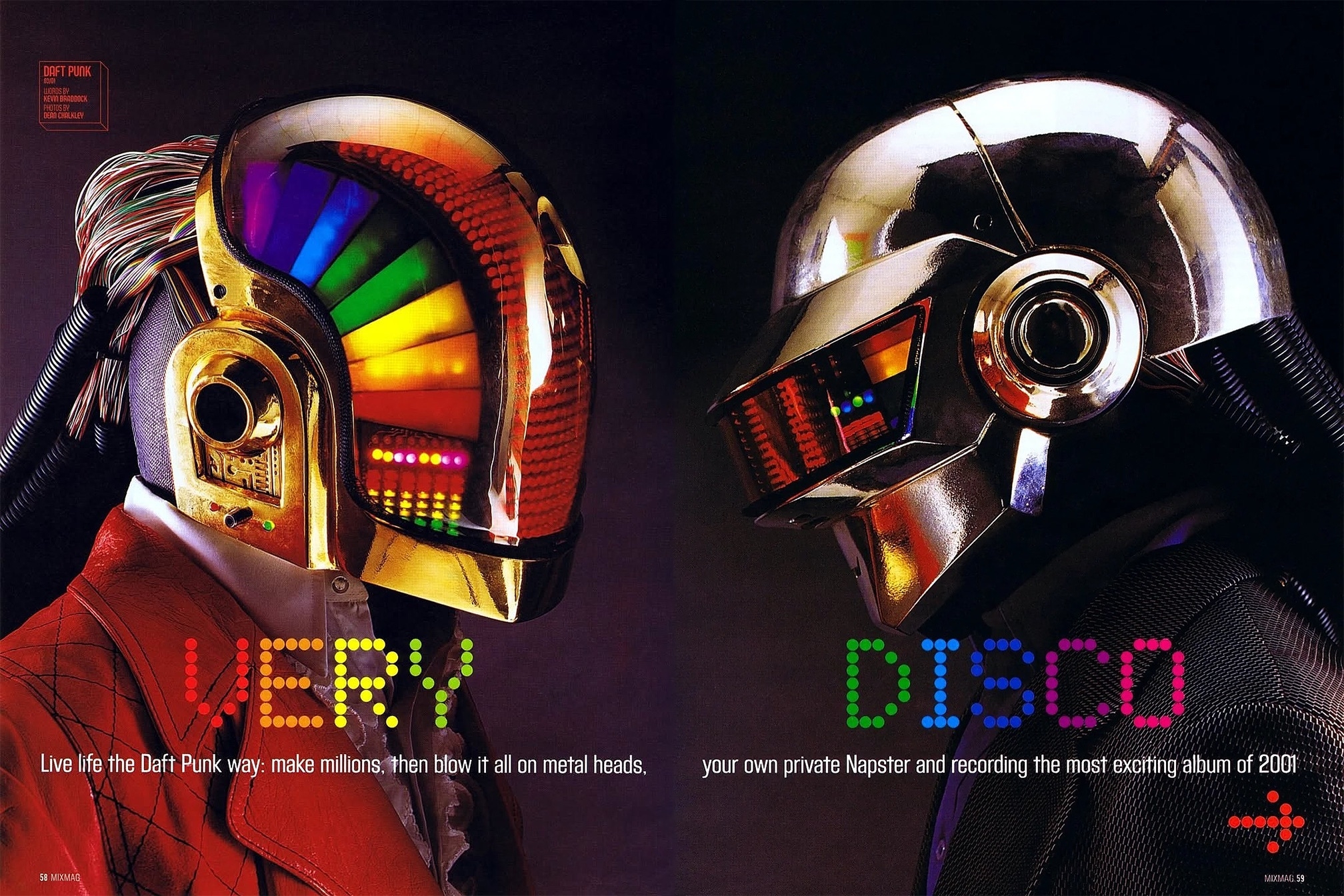
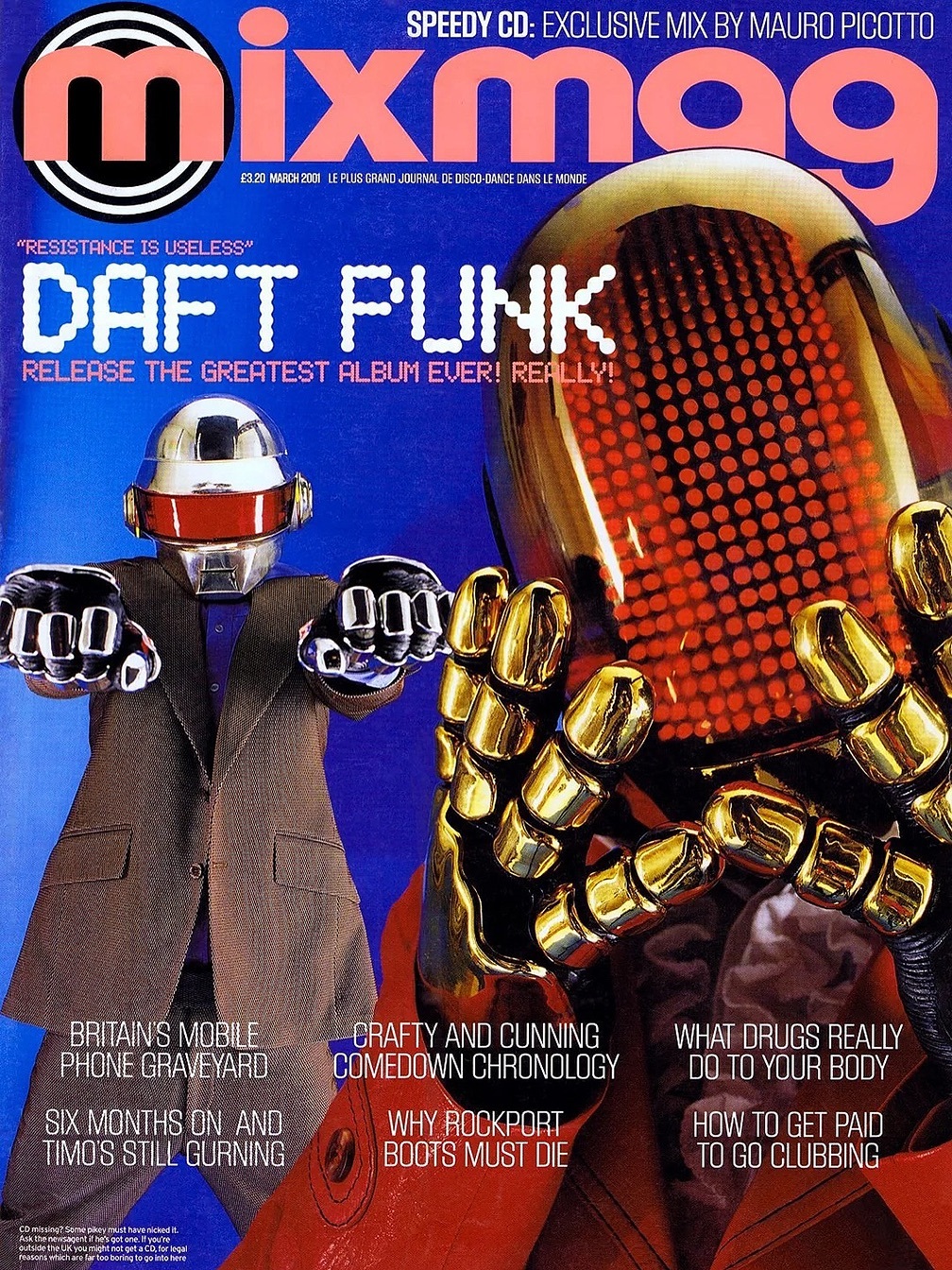
Fashion clearly operates by different rules in the Daft dimension. At Mixmag's cover shoot, in a studio under the shadow of the Eiffel Tower, a gold robot wears a flamboyant ruffle-necked shirt, red leather double-breasted overcoat and scarlet Mui Mui slip-ons. His taller, trimmer, silver counterpart sports a flared Oxfam-reject suit of a kind even Jarvis Cocker would think twice about wearing.
Setting these off are LED-illuminated helmets and backpacks that twinkle and flash hypnotically. The robots don't speak; they just stand, looking like the past, the present and Terminator Il all at the same time.
Bienvenue, wilkommen and welcome to the 2001 leg of Daft Punk's global disco pantomime which, like the last time it came to town, is about to save house music, teach the world a fresh dance move, revitalise music's flagging economy of ideas, and do more for French foreign policy than giving away Louis Vuitton luggage to every world citizen ever could. The way that they're doing that is with 'Discovery', an album which is to their 1996 debut 'Homework' what the Arc de Triomphe is to your dad's garden shed.
As Daft Punk have already pointed out, we're going to have a celebration. Dress code for the event is Daft. The world is about to go so Daft, it's just silly.
Several hours before the shoot, Thomas Bangalter and Guy-Manuel de Homem-Christo (known as Guy-Man) are ignoring the breakfast laid out in an office near La Bastille, Paris. Fellow French housers Modjo are the topic of conversation, and there are no prizes for guessing that Modjo's 'Lady' wasn't quite Thomas Bangalter's favourite record of 2000 (that was 'Untitled' by Daft Punk's Parisian rocker chums Phoenix).
"I like the acoustic version," Thomas offers. "I prefer Stardust," mumbles Guy-Man. "But I don't think Modjo sounds too much like Stardust?" counters Thomas. "Yes it does," says Guy-Man, indignantly. "It's a very nice production," concludes Thomas. "It's… entertaining, because music isn't only based on innovation. But it's not a track we'd be interested in making." Are you bothered that people copy you? "It's very rewarding [grinning broadly], and anyway, isn't copying what we did on the new album?" He grins even more broadly.
Together, Thomas and Guy-Man's personalities present a perfect hemisphere, the whole of which you'll only ever experience through their music.
Thomas is so electrified and spindly that he seems to have no bottom. But he has a complicated and immediate answer to everything to make up for it. The roomier Guy-Man (sequinned New York hoodie, dazzling Nikes, long face) is as chatty as a stone. When Thomas speaks, he chatters along in US-inflected English (he lived there when he was a child). When Guy-Man speaks, it's an event.
So, what have you both been up to? "Not that much," says Thomas. "Since we finished touring with 'Homework', we've been working. If we’d been in the studio constantly, three years would have been a very long time. But you can think about a track without being in the studio. It was about feeling our own pressure, not external pressure.”
When Daft Punk explain themselves (as far as the notoriously circumspect pair ever 'explain' anything), it's in this cautious way. To them, they've done "not that much"; to anybody else, they've changed the world with a beatbox. At the age of 26, dance music's least conventional, most visionary creatives have done more in five years than most dance outfits manage in ten. And done it wearing weird masks, too.
Since 1996, clubs have throbbed to the dense chug of Daft Punk. When they released 'Homework', their cerebral deconstruction of house, everyone stood and gasped. They were not making their music by the rules; they were making the rules by their music. 'Homework' was house's last evolutionary leap.
When the masks were pulled away and the people behind them were revealed as posh French 20-year-olds with a nous for pop-edged house verging on the virtuoso, men who'd spent lifetimes toiling in studios broke down and wept.
The filtered disco sound that Daft Punk invented seduced clubland, but 'Da Funk’, 'Around The World', 'Revolution 909' and 'Burnin' didn't make number one. However, Stardust's ‘Music Sounds Better With You' – created almost inadvertently by Thomas and some friends – did. Consequently, vocoders, filters and licky disco guitars now predominate on everything from the most underground DJ tools to Mahir's hopeless single 'I Kiss You'.
As Madonna's 'Music', Phats & Small's so-Stardust-it-hurts 'Turnaround' and Modjo's 'Lady' prove, these days, the world loves Daft Punk so much it even makes number one records on their behalf.
When the conundrum of 'Daft Punk One More Time' reached number two in a unifying national dancefloor meltdown in late 2000, opinion was divided. It was either, A: the ultimate expression of sizzling filter disco crossbred with adrenal pop and sung by a Dalek (the opinion of "true pop fans") or B: a total sell-out, with Daft Punk doing a gross commercial imitation of themselves (the opinion of "serious dance folk", who hate it when records they love sell by the vanload).
Or C (according to Bangalter): "Like a sandwich. The break is so long it's not even the break. The song itself is the breakdown." Whichever camp you were in, the level of chatter stirred up was huge.
Thomas mulls it over. "You stop putting out records for four years and then you have a track called 'Daft Punk One More Time'... that was, for us, an innocent, spontaneous thing to do. We like the message itself: Daft Punk one more time, like it's our return to making Daft Punk music. Maybe it means comeback or repetition or whatever you want. But having made that track, it was obvious we should release it first and put it first on the album."
Not only was ‘DPOMT’ written before Cher's cheeseville ‘Believe' smash took the same wobbly voice modulation effect to global ubiquity, the diva also sampled the beats from 'Revolution 909’, proving that the charts have moved towards Daft Punk, rather than vice versa. "People like to analyse and theorise," says Thomas. "We're not doing that. It's just… a track."
For clubland's tribes of Daft, however, a new track by Thomas and Guy-Man is never just a track. When Thomas and DJ Falcon's Daft Punk-by-proxy single ‘Together' hit clubs in the UK this summer, crowds sang along to its bassline, cried on dancefloors, and made fools of themselves under its influence. Some even thought it should have been the new single. It was an event like any other Daft Punk release.
The good/bad news is that 'Discovery' contains no other "sandwiches", only 12 tracks of paradigm-shifting, electrifying Daft Punkness. Those who have heard the album describe it with every superlative from "amazing" to "ginormous", and recount how their jaws crashed onto the floor as each new track opened and closed.
It's been termed "accessible", "’80s-sounding" and "poppy". But far from heading Westlife-wards, it spirals off in as many new directions as a compass in a magnet shop. What ‘Discovery' delivers is haute couture house music.
The odyssey begins with a primal 4/4 thump, ends with a primal 4/4 thump, and in between casually tosses in neo-classical arpeggios played on a 303s, pyrotechnical metal riffage made to sound like techno, pumpin' FM power-rock stitched up with wonky beatboxes and rubberised p-funk slapped over angular electro. All sewn up with more hooks than a mile of Velcro.
It's got Big Ben on it, Herbie Hancock, Steely Dan, Van Halen and Beethoven. The house/‘80s perm-rock/baroque/electro crossover tsunami starts here, possibly. "The album has house influences and non-house influences," Thomas offers, as a sort of explanation. "There are many influences: from rock to heavy metal to classical to... anything."
"The first album was more a Chicago sound," Guy-Man adds. "This one has influences from all the music we listen to, but always having the beats and the effectiveness of the club sound."
'Discovery' is the unlikely made fact. It's a product of the New Rules: a synthesis of dancefloor functionalism and blatant pop savvy, making notions of 'underground' and 'commercial’ meaningless. According to Bangalter, there's only one true house track on 'Discovery' anyway, Romanthony's spiralling, ten-minute exit track ‘Too Long'.
What's more, over the incendiary solo of 'Digital Love' (the album's apex after the chop-socky, possible next single ‘Aerodynamic’), there's Bangalter and Guy-Man singing. Singing! It sounds like a warp-speed 'Bohemian Rhapsody' to get jiggy with. It makes most house music sound medieval by comparison. Born to do it? And then some.
"We're not interested in doing the same thing twice," Thomas says. "Things have changed since 'Homework', electronic music has exploded and [with venom] it's accepted by society. The anger in Daft Punk tracks like 'Revolution 909' has no legitimate grounds to exist today because Madonna makes records like 'Music'.”
"Some people might be nostalgic, but there is no point repeating something. We create our own rules, so everyone can create their rules, which means there are no rules anymore." It's a revolution. Bring forth the guillotine!
Somewhere between ‘Homework’ and ‘Discovery’ as they globetrot alongside The Mongoloids (kindred DJs Basement Jaxx, Sneak, Roger Sanchez and Armand Van Helden), Thomas and Guy-Man completed their graduation from prodigies to near-geniuses. It’s great news for clubbers seeking oblivion amid zippy French house grooves on a Friday night; nothing short of a godsend for everyone else involved in the Daft Punk industry.
"They think deeply about what they do," says Pete Tong, who was first to play 'Daft Punk One More Time' in the UK. "Thomas is incredibly suspicious. He's the control freak.”
“They are firm about what they want, and very honourable. They've shown from the decisions they made - using Spike Jonze to direct their videos, for example - that they know what they're doing. They control their own destiny."
These It-Kids of dance don't necessarily think big, but they definitely think clever. Their principle of creative control, fostered by independence, was inaugurated well before the world knew their tunes.
"Business is a way of controlling what you want to do," says Thomas. "The main factor in what we want is independence, to be self-financing and self-producing. Before making music, we're an independent production company. The act in itself of dealing with a major label, doing things the way you want... it's a way to change things, and we have fun changing things from inside the system."
When he was 21, Thomas set up Daft Life, a production company for his and Guy-Man's music. Rather than being signed to Virgin, Daft Punk's records are licensed from Daft Life to Virgin, whose marketing and distribution power the duo exploit while retaining control over their music. Pouring over distribution deals and sales forecasts might be less fun then gathering plaudits on the international house circuit, but Thomas and Guy-Man's capacity to weave magic into their tunes as well as their business plan is key to their success. Being equally at home with sampler and spreadsheet, they've had the whole grand project sketched out from the off.
"Selling, pressing, touring... Daft Punk were the first here to do all that," Thomas explains.
Thomas and Guy-Man also control their public perception. Oral Lee, head of marketing for Virgin in the UK, is in charge of managing how the duo appear.
"We never know what they're going to do," Oral says, fiddling with the UK's sole copy of ‘Discovery' at her London office. "They do what they want: remixes, advertising, CD label copy... they're incredibly clued-up about what's going on in different territories." She adds, good-naturedly. “From a marketing point of view it can be frustrating."
As dance music goes global, only Fatboy Slim and The Chemical Brothers can currently claim anywhere near as coherent a brand image as Daft Punk. Only The KLF, Kraftwerk and The Orb have successfully hoodwinked the world into believing them to be a product as Daft Punk have.
Worldwide access to Daft Punk is choreographed through high-art videos and DVDs; colour-coding (using the same colours on the 'DPOMT' sleeve lettering as on the robot helmets and the Japan-only promotional crayon); concept-led magazine shoots that are personally approved, and sloganeering. "We like having a message," says Thomas. "What we don't want are tracks with no meaning."
This does more than just provide wicked visuals; it means public attention is focused away from the all-too-human Thomas and Guy-Man, the people, and onto Daft Punk, the thing. It would take a will of iron not to be mesmerised by their current get-up. The masks, designed with the retro-futurism of old skool games consoles, were produced at astronomical cost by special effects people in LA, and can display programmable messages in the visors' built-in LED banks. Handily, it means Daft Punk don't even have to explain their "message" anymore: they just print it on their faces.
As for access to Daft Punk the humans, well, there isn't very much. Thomas' girlfriend is an actress, we learn. Guy-Man only buys hip hop CDs — he's not interested in house music. It's Thomas' birthday on the day of our shoot (January 3rd). Guy-Man's brother's music is going well, thanks. And that's it.
Neither Thomas or Guy-Man, globally recognised for being The Men In Masks, can remember the last time they were stopped in the street. Everybody in their neighbourhood knows they make music, but nobody knows they are chart stars Daft Punk. But don't they fancy riding down Les Champs Elysées on white disco steeds as all of Paris cheers them on? Don't be, er, daft…
"We enjoy the concept of the celebrity," Thomas ponders. "Of Daft Punk as an entity. We're not making music for being famous or celebrities or being recognised or having girls around or everything," agrees Guy-Man. "That's why we put our work in front."
Out of choice, Thomas and Guy-Man didn't DJ much in 2000. They couldn't find any decent records anyway. For the time being, they're less enthralled by house music, and more by the ecstasy-fried daydreams of visionary Atlantan hip hoppers Outkast.
"They're cool," says Guy-Man. "It's like something you've never heard, really inspiring and avant garde, much more than house. It's just music that's not trying to be in any style." Daft Punk have always delighted in fighting the tide of bland, turning convention on its head. Last year, however, Thomas was struck by the revelation that music - or the ways music reaches its audience - has a capacity for change. In particular, Radiohead's rock-with-a-conscience stance and trashing of music biz orthodoxies (no singles to promote an album, no corporate sponsorship at gigs) found resonance chez Daft.
These days, the junction where business and music meet is where Daft Punk choose to stage their revolution. They're free of the money-making imperative: after ‘Homework’ and everything else, they aren't short of a bob or trillion. Their conceptual genius can be put to work on the unglamorous business of branding as art in itself.
“Sometimes, not making something can be an act of innovation," says Thomas. "There will be a video for 'One More Time', but we wanted to release it after the single, to prove video can be a creation in itself, not just for promoting something else. A lot of branding is just to sell; we are interested when it becomes more like pop art — when it's making art, not money. When branding is innovative, it is about changing the world, instead of making money."
“Ça défonce, hein?" is Parisian for “wicked, innit?". Bangalter, marching about the studio in a semi-complete robot costume and waving a credit card, half man, half Power Ranger, has just said this for the 17th time today. He's all agitation and smiles. The volume rises. A knot of French blokes coagulates around the grinning cyborg, oohing and aahing.
For a moment, Thomas looks likely to disintegrate with excitement. The credit card in question is the first Daft Club membership card, one of which they plan to include in every copy of 'Discovery'.
Having subverted the rules of dance music, rewritten business theory and conceptualised their way through branding culture, Daft Punk's next trick for 2001 is to out-Napster Napster, the music-sharing software that is the biggest music biz bugaboo since sampling made musical theft legitimate. While the world empties its bank account trying to set up a meaningful online presence, Daft Club offers a combination of portal, supermarket loyalty card, members-only online experience and micro-Napster.
Sign up with the number embossed on your card, and bingo: a whole new world of downloadable Daftness awaits — "for free," stipulates Thomas, firing up a VAIO laptop for an impromptu run-through.
"Audio and visual content, remixes, new tracks. The cool thing about Napster is that it gets music first. I think 'Discovery' will be on Napster before it's in shops. But now, everything will be first on Daft Club."
Instead of grumbling about online piracy as some of their peers have (stand up Basement Jaxx), Daft Club steals the lead back from Napster. Ingeniously, it also puts Thomas and Guy-Man in direct touch with their audience.

Daft Club cost a fortune to produce, with no guaranteed return: that's what you call love for your audience. "We've spent most of our money on videos for 'Homework' and now Daft Club. We're paying for this. This is a gift," Thomas reasons.
"We agree that CDs are too expensive. But instead of attacking Napster, we had a dream of setting up a new model and doing something more appealing. There's no reward in buying a CD when you can get the same music on Napster. The thing is to make the buying experience more personal and entertaining, emphasising membership. It's a community. What is music if it's not having things in common with people?"
Swarthy art director Alex Cortex strolls over and paws the Daft Club card. "They have so many ideas," he murmurs. "So many people we make videos for have no idea what they want. All they ever say is, 'No, I don't like it’." Anyone who's seen the lysergic speedway-gone pop-art promo he and his partner Martin Fougerol made for Cassius' ‘1999' will recognise the pair as no creative slouches themselves. While we're meeting the troops, there's Pedro Winter, the towering 25-year-old production manager, all-in-one confidante and problem-solver; doe-eyed Gildas, Guy-Man's ex-roomie and chargé d'affaires at Daft Punk's Roulé and Crydamoure offshoot labels; and dreadlocked Cedric, whose excessively baggy jeans seem certain to rendezvous with the floor any minute now.
This is Daft Team, the creative nexus of a community which includes producers Alan Braxe, Benjamin Diamond, DJ Falcon, Cassius and Phoenix, and directors Spike Jonze, Seb Janiak and Roman Coppola. They're the support crew, working even further behind the masks than Thomas and Guy-Man; they answer calls at the Daft House offices in Montmarte, manage affairs for Daft Trax studios, contribute ideas to the Daft Life production company and generally keep the Daft machine oiled.
Nevermind the international honk-ups, such as the continuing non-event that is the Mongoloids album (“nothing is happening with that," says Guy-Man, shrugging). The creative streams run deepest right here amid the chummy esprit de corps of Guy-Man and Thomas' mates, where bonkers sci-fi helmets, absurd video concepts, and new laws of house physics are concocted between considerable periods of spliff-smoking and messing about.
"It's not like a work job," mutters Gildas. "We are friends at the beginning and we stay friends."
"Everything is done for fun," adds Pedro.
A final figure completes the Daft Punk outfit. He's a man who defined the ‘70s by writing Ottawan's 'D.I.S.C.O.’: Bangalter's dad, Daniel Vangarde. Some call him a genius; if so, it runs in the family. He's important to the Daft Punk game plan and now officially "on board".
"He is working as an advisor," Pedro says, "He did it for the first five years anyway. He is a guide. But he has a new vision, like us, so we match perfectly."
On the other side of the studio, the robots totter about with Thomas and Guy-Man labouring somewhere inside. It seems absurd to believe that the actions of a pair of 26-year-old men who enjoy dressing up as Space Invaders should be so important, but then dance music has never been in such need of imagination and ambition.
"I'm sure they have something nobody can understand," Pedro observes. "They are really close. But, you know, the real reason they wear the helmets? They are shy."
So here are the world champions of house, constructing revolutions as if they're paper planes. One day, Daft Punk may quit making tunes and take up cybernetics just for the challenge. When they do, they'll probably dress up as scruffy dance blokes for the cameras. Until then, dance music's geniuses will carry on acting daft so you don't have to. You can join them if you want to; the offer's there. And take it from us, you will.
This feature was taken from the March 2001 issue of Mixmag.
