


Salmon swim faster and further on cocaine, study finds
Scientists exposed 105 wild salmon to cocaine in Sweden's Lake Vattern to conduct their research
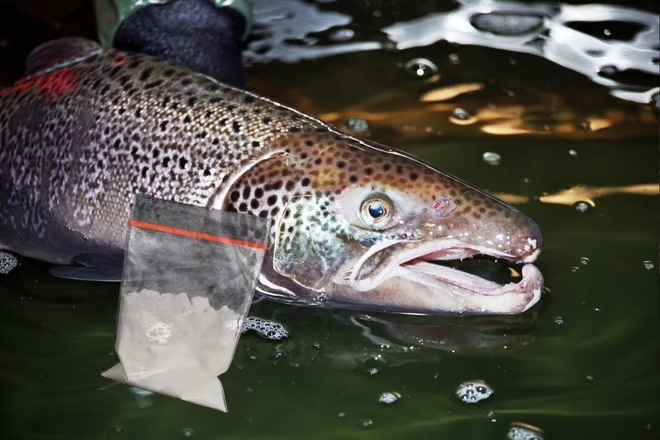
Salmon swim twice as fast and explore a greater distance when swimming in water laced with cocaine, a new study has found.
The joint research between Australia's Griffith University and the Swedish University of Agricultural Sciences set out to understand how an increase in cocaine use from humans can impact fauna in the world's waterways; the UNODC World Drug Report 2025 estimates that 25 million people used cocaine in 2023, up from 17 million in 2013.
Read this next: Sharks in Brazil are testing positive for cocaine, according to scientists
Scientists tracked 105 wild Atlantic Salmon in Sweden's Lake Vattern, after exposing them to cocaine and benzoylecgonine — a derivative of cocaine which is created in the human liver after consumption and commonly detected in wastewater.
Findings reveal that the salmon exposed to cocaine swam "1.9 times faster" than the control group and dispersed "12.3km farther" across the lake. The research also suggests that benzoylecgonine has a greater effect on salmon than cocaine itself.
Read this next: Colombian President claims cocaine "is no worse than whisky"
The study argued that changes in the fishes' habits "became more pronounced over time", indicating a significant shift in behaviour with the potential to alter the natural eco-system.
“Where fish go determines what they eat, what eats them, and how populations are structured,” the study's co-author Dr Marcus Michelangeli said. “If pollution is changing these patterns, it has the potential to affect ecosystems in ways we are only beginning to understand.”
You can read the full study here.
Megan Townsend is Mixmag's Deputy Editor, follow her on X
