


“Nepali youth have minimal employment”: Gen Z uprising targets “nepo kids” & corruption
The clashes after a social media ban led to the deaths of 21 people, forced the closure of Kathmandu’s airport, and prompted the Prime Minister’s resignation
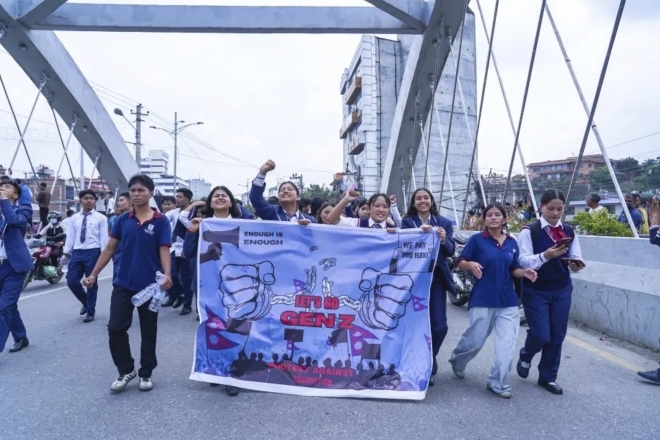
A movement spurred by Gen Z has taken to the streets of Nepal in a mass uprising against so-called “nepo kids”—a term young Nepalis use to describe the children of top government officials and ministers.
The protests erupted after the government banned 26 social media platforms on September 4, including WhatsApp, Instagram, and Facebook.
What began as a digital crackdown quickly escalated into violent clashes that left several dead and forced the resignation of the Prime Minister.
By September 8, demonstrations had spread across Kathmandu. Organised by several online communities—including the non-profit Hami Nepal—the protests drew thousands of young participants demanding change after years of corruption and inequality.
According to Aljazeera, the so-called “Gen Z protest” began on the morning of September 8 with official approval from the Kathmandu District Office, before rapidly spreading to other cities.
Tensions escalated when demonstrators, some still in high school uniforms, broke through police barricades and stormed the grounds of parliament.
Read this next: “The system constantly undermines us”: protests in Jakarta expose anger over parliament pay, labour rights & police violence
So far, 19 protesters and two police officers have been reported dead, though an official death toll has not yet been confirmed. Seventeen demonstrators were killed in Kathmandu, with two others in Itahari.
Human Rights Watch reported that over 300 people were treated for injuries sustained during the clashes.
The protest, which carried into Tuesday (September 9), brought the closure of Kathmandu’s airport. In response, authorities imposed a nationwide curfew, urging citizens to remain indoors and avoid non-essential travel.
Read this next: Founder of Berlin venue Oyoun joins Global Sumud Flotilla in aid of Gaza
The violence and mounting casualties prompted several ministers, including Prime Minister Khadga Prasad Sharma Oli, to step down. While no further demonstrations were reported on Wednesday, smoke continued to rise from burned buildings across the capital.
Explaining the roots of the unrest, Priyankar, a Nepali curator and researcher who helps run several art spaces in the country including Kalā Kulo, told Mixmag Asia: “Many working-class Nepali youth have minimal employment and socioeconomic mobility in the country. The protest was entirely youth-led and organised on the internet. When the government banned social media, they coalesced to protest against a corrupt system that was stifling them.”
Via BBC
Image via Ambir Tolang (Human Rights Watch)
Daniela Solano is a freelance writer for Mixmag Asia, follow her on Instagram here.
Cut through the noise—sign up for our weekly Scene Report or follow us on Instagram to get the latest from Asia and the Asian diaspora!
