


 Music
Music
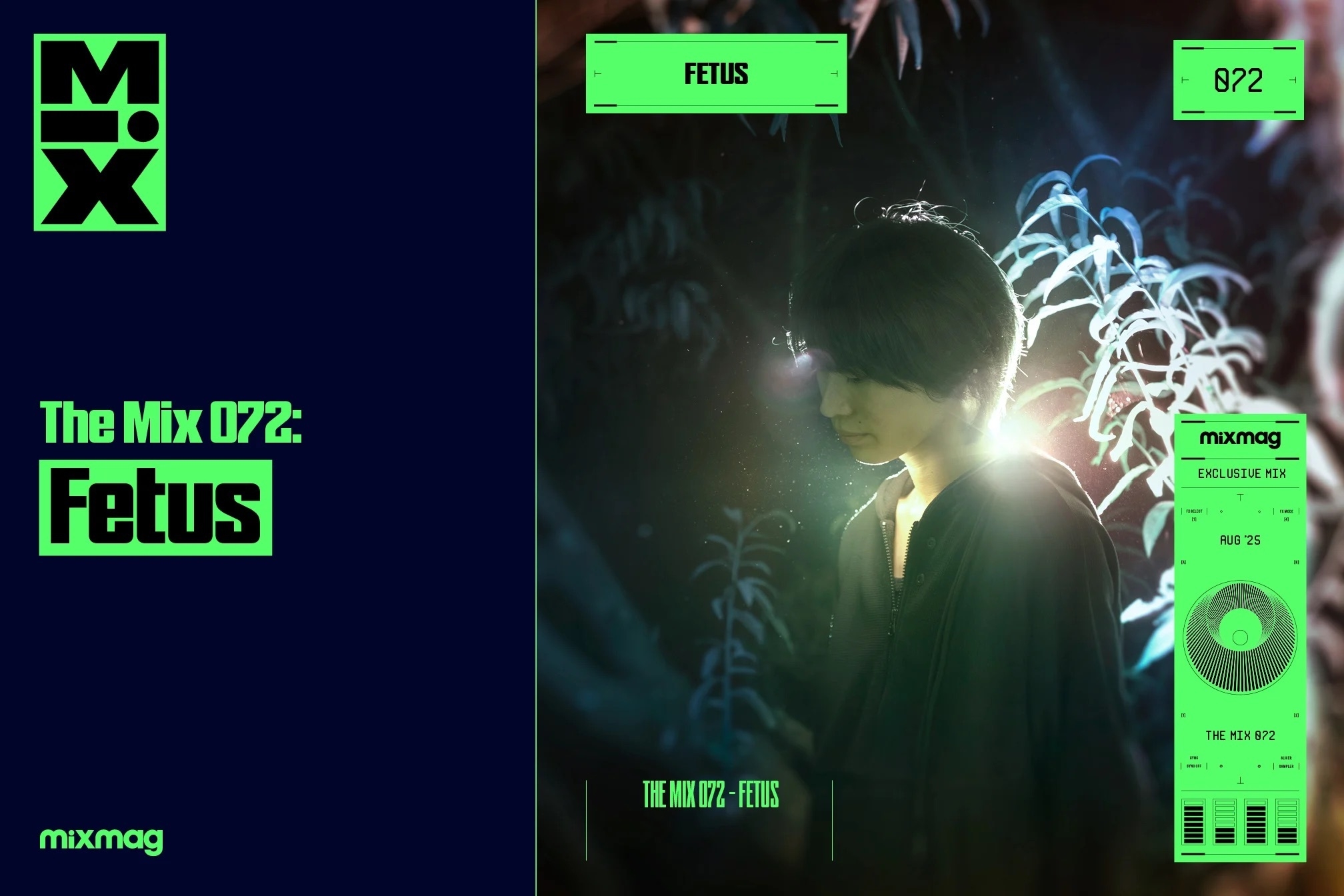
The Mix 072: Fetus
Japanese artist Fetus makes intense and uninhibited music that transcends physical limits and language — and it's catching attention across the world. He shares a high-energy mix and speaks to Patrick Hinton about refusing restrictions, Tokyo's club scene, and the emotional inspiration behind his artist name and debut album
There’s a restrictive school of thought in dance music that artists should stick to one particular sound or scene, lest they confuse promoters or potential fans about what to expect from their music and suffer career consequences. Japanese DJ and producer Fetus does not accept this way of thinking — constraints make him feel uneasy inside. “Limiting myself to one genre would make my core feel blurry,” he declares.
Fetus’ artistry is uninhibited and intense, tapping into his own experiences, emotions and the universality of music to convey meanings that can resonate with anyone. Born in Osaka and now based in Tokyo, a wildly prolific 2024 saw his next-level productions duly make waves and rewire minds across the world, landing a spot in Mixmag’s top 25 producers who defined the year.
The standout release was his debut album ‘b1 b2’ on the TREKKIE TRAX label he has formed a productive partnership with. Encouraged to create without limitations, the 15-track LP and follow-up remix EP spiral from drum ‘n’ bass rooting into influence from dub techno, footwork, tech-house, acid and more in a thrill ride of sounds.
The album is conceptually linked to his late brother, while his artist name reflects his aim to express all available avenues of music experimentation, like a child in utero who has a full life of potential and possibilities ahead of them.
“I chose the name ‘Fetus’ because I want to live without regrets after being born, without being tied to any one genre,” he explains. “It also reflects my desire to experience as many perspectives and musical styles as possible, partly for my brother. I absorb different ways of thinking and backgrounds, shaping the ones that resonate into sound.”
His own childhood didn’t involve much music or growing up in a musical household, though exposure to his aunt’s love for J-ROCK in middle school and dance lessons inspired him to start listening with intent rather than just what was playing on TV. “I would go to Tower Records, buy CDs at random without knowing much, and spend my days listening to them,” he recalls.
Entering his early teenage years, EDM and dance music came to the fore. “Like many middle schoolers, I went through a phase where I thought the louder the music, the cooler it was. During that time, Skrillex’s ‘Recess’ blew me away, and that’s when I first wanted to make my own tracks,” he says. “Back then I used SoundCloud a lot, without paying much attention to genres, but when I lined up my favourite tracks, most of them turned out to be drum ‘n’ bass. That realisation led me to explore its subgenres and made me aware of my preference for faster tempos.”
Clubbing came later, with spots like Circus Toyko providing formative experiences that pulled him deeper into the underground. Although his own DJ career started out with slower, deeper sounds, a connection with Parisian bass and pace don Amor Satyr in Tokyo pushed him to higher energies in his sets.
Fetus co-founded a club night and later label called Turing with Oyubi, recently bringing plenty of breaks-laden chaos, headfuck percussion and ambient sheen to dancefloors and USBs, alongside a pneumatic releasing of tracks, remixes and EPs across various styles and outlets, including contributing to a compilation for beloved Berlin queer collective Herrensauna. Having also just travelled to play abroad for the first time at Cakeshop in Seoul, more international attention looks assured.
Fetus is more than an artist to watch — you can’t take your eye off him for a second with all the bangers he’s unleashing. In hist first-ever interview below, we delve into his mood-based music-making that transcends physical limits and language and Fetus shares a dynamic mix which represents the direction the project is heading.
How has Japanese video game music inspired your route into music and approach to production? What are some of the most influential games?
In my club and dance music work, there’s often a sense of “borrowed scenery” rather than pure physicality. For me, games have always been a natural, distinctly Japanese way of experiencing electronic music since childhood. Two that had a big influence are moon and Pikmin. Both create an atmosphere that alters your perception of time and space, with a strange, surreal feeling. That sense of subtle dissonance and playfulness has definitely shaped my work.
You were born in Osaka but are now based in Tokyo right? When did you move and why?
There were two main reasons. First, in Osaka there weren’t many producers my age with similar musical directions. Second, I was getting more bookings from Tokyo than from Osaka. So in December 2022, I moved with just my laptop.
How do you find the dance music and club scene in Tokyo? Does it feel like it’s in a good place? How are the parties? Is there a sense of community?
Tokyo’s club scene is incredibly diverse. It can’t be summed up in one word. Different genres and atmospheres coexist, each with its own strengths. If you try to capture the whole picture, you risk seeing an illusion of a unified “Tokyo club scene.” There are definitely great parties and communities, but whether they can be grouped under “Tokyo” is another matter.
Read this next: Mixmag Asia Radio: TREKKIE TRAX CREW share set from Summer Bass Jam Festival
You’ve become a core artist on TREKKIE TRAX with multiple releases through the imprint. How did you get involved with the label and how do you find working with them as a collective?
In high school, during the golden age of SoundCloud and netlabels, I admired TREKKIE TRAX as a fan and checked their releases regularly. I first met the members when Fellsius, who’s the same age as me, took me to a recording at Tokyo’s block.fm. TREKKIE TRAX treats artists with genuine respect, which is rare. In Japan, I don’t think genre-fluid music is widely accepted, but they’ve always supported my vision. I’m truly grateful for that and want to keep working with them.
The release notes for your ‘b1 b2’ album note that you chose your artist name as an uncategorisable alias that’s not tied to any specific genre. What draws you to merging myriad different sounds in your music?
The album’s concept revolves around my late brother — not in a literal narrative sense, but more as a way of moving past my own trauma. I chose the name “Fetus” because I want to live without regrets after being born, without being tied to any one genre. It also reflects my desire to experience as many perspectives and musical styles as possible, partly for my brother. I absorb different ways of thinking and backgrounds, shaping the ones that resonate into sound. It’s a natural process, and maybe that’s why I’m drawn to crossing genres and blending sounds.
Often DJs worry that if they’re not associated with a particular sound it means audiences and promoters won’t get them or where they fit in dance music, and it will impact their career, which doesn’t seem to be something you concern yourself with. Is it important for you to be able to represent the full spectrum of your interests in your music?
Yes, but more than that, it’s about channeling the sensations I’ve accumulated directly into my work. When I take in music, I focus on the artist’s perspective — what emotions or background they’re creating from. Limiting myself to one genre would make my core feel blurry, which makes me uneasy. So while it may look like I’m crossing genres, it’s simply my natural way of expressing myself.
You’ve been showcasing the range of your artistry since your debut with a stacked schedule of releases across a wide range of labels. How are you able to be so prolific?
I often explore what drives the artists I admire to create. Even outside of music, trying to understand the inner worlds of friends or artworks naturally sparks my own motivation, leading to unexpected creations or simply giving me energy. Above all, I just enjoy making music. That’s the real reason I can keep producing so much.
How do you decide what type of music you want to make when you sit down to produce? Does it depend on your mood?
It depends heavily on my mood. I have a daily habit of opening my DAW without deciding in advance what to make. I incorporate impressions from daily life, especially club experiences, into my work. I open an existing project template that fits my mood that day and gradually shape it from there.
Are there any unifying themes or aims to your approach to music-making that make each track a “Fetus” record do you think?
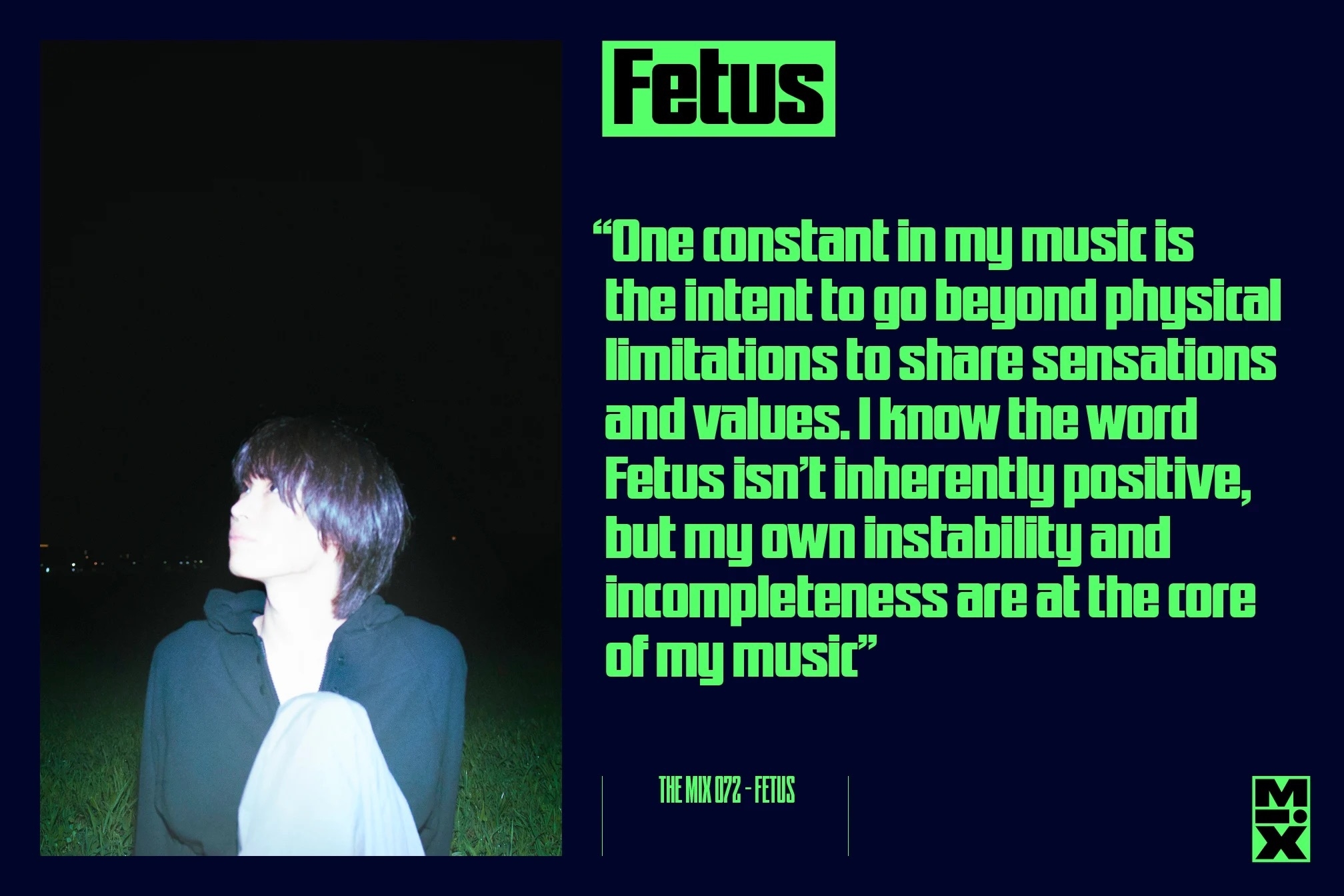
One constant is the intent to “go beyond physical limitations to share sensations and values.” I know the word “Fetus” isn’t inherently positive, but my own instability and incompleteness are at the core of my music. I believe the moments when values naturally resonate through music—transcending distance and language—are deeply meaningful. In a way, my eternal theme is to give “Fetus” a positive meaning.
How has it felt to have so many labels, including international imprints such as Herrensauna, interested in releasing your music?
Since I make many genres, I’m sure some people wonder, “What is this person trying to do?” But being approached by labels like Herrensauna genuinely makes me happy. Even if the genres differ, I feel a mysterious connection. It’s as if they see my core energy and drive rather than just the style, and I’m grateful for that.
Read this next: The Mixmag Asia Music Guide: Japan
You founded the Turing label with Oyubi. What are your aims for that project?
It actually started as a party, without a big conceptual launch. But Turing feels like a space where Oyubi and I can compare and tune the inputs we’ve each gained elsewhere. It’s more about drawing out each other’s creativity than setting big goals. The releases are like our abstract conversations, so I hope people will check out the music as if they’re listening in on that dialogue.
Is your approach to DJing equally eclectic or are you more focused on sounds that will make people dance in the club?
I originally played deeper, slowly built sets, but now I often play high-energy 160 BPM sets aimed at dancing. This shift happened after Amor Satyr visited Japan. We collaborated, I saw his DJ set, and we talked. At the time, I wasn’t in the best mental state, but through small, casual exchanges, I unexpectedly felt uplifted. That made me more positive, and since then I’ve leaned into bouncier, dance-focused sets.
I saw you got a passport played outside Japan for the first time on August 9 at Cakeshop in Seoul. How was that as an experience?
I’m grateful to ROBBLE at Cakeshop for having me. Playing overseas had always been a dream, and I never thought it would actually happen, so I was nervous the whole time. On top of that, it was a three-and-a-half-hour B2B with Oyubi, and the Seoul crowd kept dancing until the end. It was the first time I truly understood the power of sharing music across borders. I felt like I was finally at the starting line. It was an unforgettable night.
What are your plans or aims for the future?
My ultimate goal is to better understand myself through music. To do that, I want to keep encountering different people and works, deepening and expanding both my sound and my inner world, while continuing to share moving experiences. I also want to expand my activities overseas, so my immediate goal is to improve my English.
Can you tell us about the mix you’ve made for Mixmag?
It focuses on the “new Fetus” after my album. It’s a BPM 160 mix that reflects where I’m heading, including collaborations and tracks from friends who have supported me. I think it captures the current full picture of Fetus, built on a foundation of dance. I hope people enjoy it.
Check out Fetus on Badcamp here
Patrick Hinton is Mixmag's Editor & Digital Director, follow him on Twitter
Tracklist:
Amor Satyr & Fetus - ID
Fetus - Mosci
Croixrouge - Lazer Gun (Siu Mata & Amor Satyr Remix)
Albino Sound - Purity (RWD)
Guide - Lemons
Baji - Alfa Loco
Privacy & Fetus - ID
Prince Pasensi - LUKU FINI
Piezo - Ultra
DJ Strawberry - Straight, forward (Pharakami Sanders Remix)
DJ Strawberry & Fetus - Leads United
Hysteria Temple Foundation - Submarine Drift (Stenny Remix)
El Irreal Veintiuno - TL-DM
pìccolo - SEXYARACHA
Fellsius & Fetus - PICCOLO
Simo Cell - Paris Funk Express
Avi Loud & Liano - Uh-Oh
Kush Jones & Oyubi - Sin Jyuk Guen
Oyubi - ID
Toma Kami - Immature Cheddar
Fetus & Dayzero - Origin
Sun People - No Fear No Hope
Naco - Ows
Slacker - Certain Devils (georg-i's cheeky little devil mix)
